
Is Robroyston Glasgow’s latest 'desert wi' windaes'?
After the Second World War, Glasgow Corporation, faced with a housing crisis and inspired by municipal socialism, boldly built more social housing than any other city in the world, excluding Hong Kong.
Four peripheral ‘overspill’ schemes – Castlemilk, Drumchapel, Easterhouse, and Pollok – were built to keep Glasgow’s population within the city boundaries, providing modern, sanitary homes for those displaced by slum tenement clearances.
The all-out effort for new municipal housing was certainly a laudable ideal for the city’s planners and politicians, many of whom grew up in the infamous ‘single end’ slums of the early 1900s. Yet, the new schemes were inadequately linked by public transport to the city’s jobs and recreational amenities. To this day, they lack many basic facilities and services.
Billy Connolly described his move from a cramped tenement flat in Partick to a gleaming new five-apartment house in Drumchapel aged 14, as like arriving to a 'desert wi' windaes'.
Since the 1990s, sprawling private housing estates have been built around the city’s periphery. The intention of these new areas was to make Glasgow more balanced in terms of wealth and social class, while boosting much-needed Council Tax revenue, but city planning continues to repeat the mistakes of the past.
Growing up in neighbouring Auchinairn, I have always known Robroyston as an example of this. Young families aspiring to buy their first home were lured in by developers with the promise that a proper town centre would soon be built.
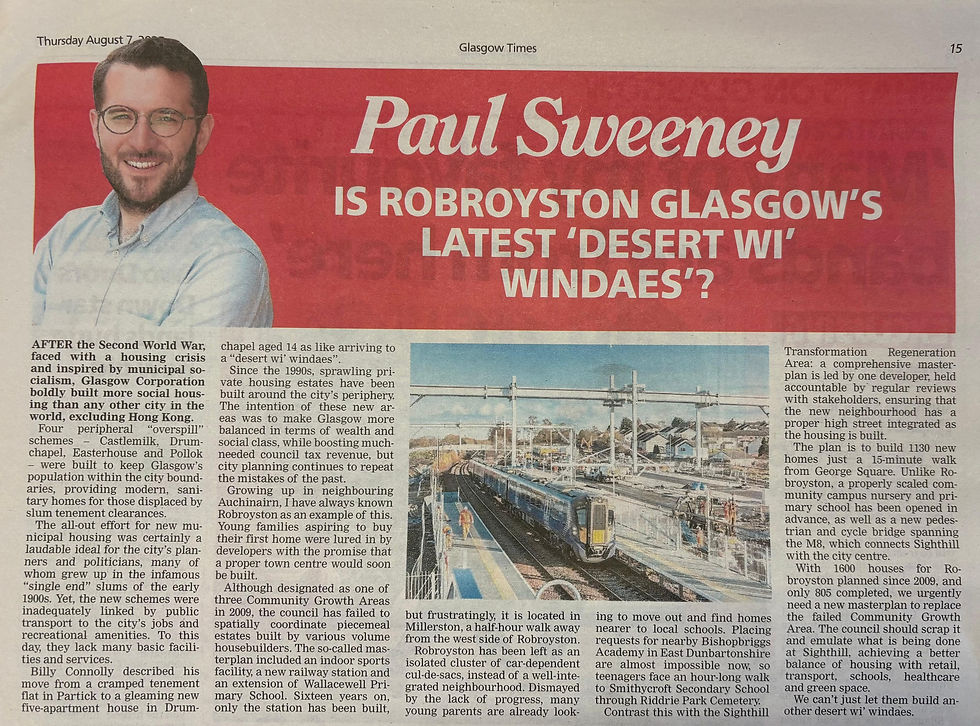
Although designated as one of three Community Growth Areas in 2009, the Council has failed to spatially coordinate piecemeal estates built by various volume housebuilders. The so-called masterplan included an indoor sports facility, a new railway station, and an extension of Wallacewell Primary School. 16 years on, only the station has been built, but frustratingly, it is located in Millerston, a half-hour walk away from the west side of Robroyston.
Robroyston has been left as an isolated cluster of car-dependent cul-de-sacs, instead of a well-integrated neighbourhood. Dismayed by the lack of progress, many young parents are already looking to move out and find homes nearer to local schools. Placing requests for nearby Bishopbriggs Academy in East Dunbartonshire are almost impossible now, so teenagers face an hour-long walk to Smithycroft Secondary School through Riddrie Park Cemetery.
Contrast this with the Sighthill Transformation Regeneration Area: a comprehensive masterplan is led by one developer, held accountable by regular reviews with stakeholders, ensuring that the new neighbourhood has a proper high street integrated as the housing is built.
The plan is to build 1,130 new homes just a 15-minute walk from George Square. Unlike Robroyston, a properly scaled community campus nursery and primary school has been opened in advance, as well as a new pedestrian and cycle bridge spanning the M8, which connects Sighthill with the city centre.
With 1,600 houses for Robroyston planned since 2009, and only 805 completed, we urgently need a new masterplan to replace the failed Community Growth Area. The Council should scrap it and emulate what is being done at Sighthill, achieving a better balance of housing with retail, transport, schools, healthcare and green space.
We can't just let them build another desert wi' windaes.
You can read my column in the Glasgow Times here: https://www.glasgowtimes.co.uk/news/25372711.we-cant-just-let-build-another-desert-wi-windaes/

Comments